When Your Child Turns to ChatGPT First: Peer Orientation, Attachment and Belonging in Hong Kong Families
Relationship with AI and chatbots for Hong Kong teenagers
Summary: The Chatbot Can't Hold Them: Parenting Connection in the Age of AI
Hong Kong family therapist Lisel Varley explains peer orientation, AI, and what happens when children lose their compass. Read on to reflect and understand attachment, screens, and how families find their way back.
Evolving community: The stable village most of us never had here

Parenting in Hong Kong as an expat family, or as a local family navigating the particular pace of this city, is genuinely different from parenting inside a rooted, stable, long term community. Most of us are raising children without the organic village that would once have held them: grandparents nearby, aunts and uncles who knew them by name, neighbours who watched them grow up.
Add longer working hours, children spending the majority of their waking time in structured peer settings, and screens that allow peer contact to continue long after bedtime, and we have created the conditions for something developmental psychologist Gordon Neufeld calls peer orientation. Not peer friendship. Something different and, left unaddressed, something genuinely chaotic for a developing child.
When children lead children

There is a reason William Golding’s Lord of the Flies still lands so heavily in the gut. Strip away the adult anchors, give children only each other for direction and validation, and what follows is not a harmless peer culture. It is chaos. Not because children are bad, but because children are not designed to raise each other.
A peer group, however warm and well-intentioned, cannot offer what a securely attached adult can. It cannot offer unconditional acceptance, because peer belonging is almost always conditional. What we see in peer-oriented children is not defiance. It is drift. A chaotic, anxious search for belonging and direction in a place that simply cannot provide it.
What AI adds to this picture

I want to be transparent about where I stand. I am not anti-AI. As a working professional and a mother, I am genuinely curious about it, constantly exploring ways to use it well, to buy back a little time in a week that never quite has enough of it. I am also a woman in my forties with a fully developed prefrontal cortex, years of training in human relationships, and the emotional intelligence to sense when a tool is serving me and when it is not.
A child with a still-developing brain is in an entirely different position.
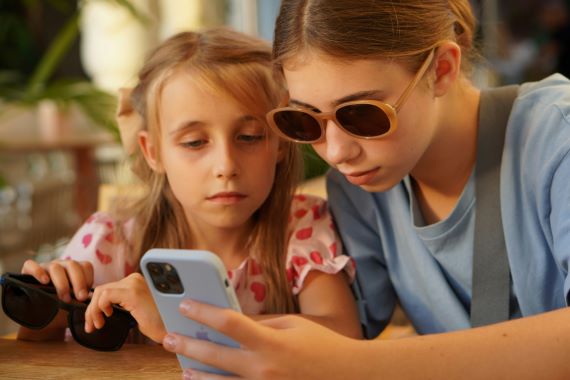
ChatGPT does not get tired. It does not get frustrated. It validates, reflects, and engages around the clock with infinite patience and no judgment. For a child not yet anchored in their own identity, that pull is not hard to understand. The danger is not that AI is sinister. The danger is that it feels like connection and feels like direction, while delivering neither in any form that actually nourishes a developing self.
Three things I genuinely worry about
1. The erosion of critical thinking. When children outsource reflection, reasoning, and problem-solving to a tool before those faculties have had a chance to develop, they lose the very practice that builds them. Struggle, uncertainty, and sitting with not-knowing are not obstacles to learning. They are the learning.
2. Over-reliance without the tools to evaluate it. The prefrontal cortex is not fully developed until the mid-twenties. Handing a developing mind an authoritative-sounding tool and asking it to trust the output is asking a great deal of a brain not yet equipped to question it.
3. The slow replacement of rupture and repair. AI never ruptures. It never needs repair. A child who gradually comes to prefer interactions that never challenge or disappoint them may find real human relationships increasingly hard to tolerate.
What this looks like at home

Two parents, both working in demanding professional roles. A twelve-year-old daughter who, by most measures, was doing well. Kind, curious, not in crisis. And yet something had shifted. She dismissed her parents’ ideas without a second thought, but accepted the exact same idea the moment it came from a friend.
In our transient, high-achieving city, these signs are easy to misread as ordinary teenage moodiness. They are not. They are a child adrift, looking for direction and belonging in the only places she could currently find them.
The phone while not the problem, is the amplifier.
The friendships do not leave the school gate anymore. They come home in the pocket. They are there at the dinner table and under the pillow and first thing in the morning.
The four things that made a real difference
1. Breakfast as a gathering, not a departure. Phones off the table on school mornings. Ten minutes of conversation before the day took over.
2. Hanging by the fridge. A snack together when their daughter walked in. No agenda, no homework questions. Just side-by-side time. Children talk sideways.
3. Three dinners a week, together. Phones in the other room, television off, nobody required to perform being fine.
4. Letting the friendships be left at the gate. Her phone went to charge in the kitchen from nine in the evening. Not as a punishment. As a gift.
By week three, she was lingering at breakfast. By week five, she was the one starting the conversation at dinner. What her parents noticed most was a gradual return of ease.
Where belonging is meant to begin
A child first needs to belong to themselves. Then to family. Then to community. And from that scaffold, securely in place, they can explore peer relationships and yes, even technology, freely, without losing themselves in either.
Peer orientation is what happens when children reach for belonging at the outer rings before the inner ones have been secured. The drift, the chaos, the anxiety of a child who has lost her compass — these are not character flaws. They are the predictable result of an attachment need going unmet. And they are entirely reversible.
Rebuilding attachment does not happen through grand gestures. I have watched families find their way back to each other one ordinary conversation at a time. A drive to training. A meal without phones. Ten minutes at the end of the day when nothing is being fixed or corrected.
Connection before correction. Warmth before expectation. Presence before technique. Attachment before anything else.
With warmth,
Lisel
If any of this strikes a chord and you need a safe, non-judgmental, accepting space to process your struggles and figure out a path forward for you and your family, please reach out for a safe, confidential discussion.
Related blog stories


Join our community