I Am a Screenophobe. Then a Panel Changed My Mind

Screentime for kids and teenagers
Screentime requires thinking in "shades of grey"
Right up to this point I was guilty of adopting a binary view on screentime. I had been applying a one-size-fits-all position to something that is genuinely not one size. It is not black and white. It may even be more than fifty shades of grey. A recent panel that I was fortunate enough to be part of had me reevaluate my opinions. Read on for some of the key discussions and some boundaries that I am confident will allow you to support your neurotypical and neurodivergent children alike.
Screentime limits: viewed from a different lens

I will be honest with you about where I started.
I am, by instinct, a screenophobe. I have wanted to delay smartphones for my children for as long as possible. I still hope I can. I have tried to keep them off online gaming. I believe, deeply and genuinely, that in-person connection, boredom, physical play, and time in nature are the things that build the kind of nervous system I want my children to grow up with.
That position has not fundamentally changed. But something shifted in me recently, after being one of the panelist on a global platform recently. I think it is important that I share this with you as I do not think it gets talked about enough in the conversations about screen time that I see circulating in Hong Kong parenting circles.
I was on a panel recently at a Q&A run by Big Life Journal and Growthminded's community, on the topic of screen time limits. And a question came up that not just stopped me, but had me thinking. It most certainly was a clear case of prompting me out of my "black and white" ideologies to thinking in shades of grey.
What about the children for whom in-person social interaction is genuinely, neurologically hard? The children who are neurodivergent, who find the unspoken rules of the playground confusing, who are exhausted by face-to-face interaction, who have tried to make friends in the ways that work for other children and found it painful. For those children, online communities are often not a distraction from real connection. They are the place where real connection actually happens.
I sat with that question for a long time after the panel ended.
I had been applying a one-size-fits-all position to something that is genuinely not one size. It is not black and white. It may even be more than fifty shades of grey.
What I now believe

The research is clear that social isolation is the most significant risk factors for the mental health of young people. For neurotypical children, in-person interaction is often the most natural path to connection.
For neurodivergent children, the barriers to in-person connection can be high enough that online communities become the place where they are finally understood, finally seen, finally able to be themselves without the exhausting performance of trying to pass as neurotypical.
To take that away in the name of screen time limits is, in some cases, to remove the primary social lifeline a child has.
That does not mean there are no limits. It means the limits have to be thoughtful, contextual, and built in conversation with the child who is living inside this situation. Not imposed from the outside by a parent who, however well-meaning, is applying a framework that was built for a different kind of child.
All interactions, even the ones that happen on a screen, need tending. They need limits, boundaries, and the presence of an adult who can empathise and guide awareness to what is happening inside them.
My reconstructed thinking: six principles
Here is where I have landed. Not a rigid rulebook, but a framework for thinking. This framework holds whether your child is neurotypical or neurodivergent, whether you are in Hong Kong or anywhere else, and whether your child is six or sixteen.
01 Call a family meeting first
Before you set any rules, get everyone around the table and have an honest conversation about what is reasonable. Children who are part of making the rules are far more likely to respect them. Ask each person in the family: what do you think would be fair? What do you use screens for that matters to you? What might be the consequences for repeat pushed boundaries?
A child who feels part of the decision making process not only feels valued and like they belong, but they are also more likely to comply with family rules designed to protect and safeguard them.
02 Screen time is a privilege, not a right
For all family members, screens sit alongside the other things that make our household work: routines, chores, homework, contribution. We link screen access to respectful behaviour and family participation, not as a punishment, but as a natural consequence of being part of a family that looks after itself.
03 Limits matter, and they are upheld kindly and consistently
Even the interactions that happen online need a shape. Time limits, agreed in advance, are not punitive. They are a form of care. The child who knows that gaming ends at seven has a structure to rely on. The one whose screen time has no edges is the one who is most likely to lose themselves in it.
04 Strangers online are strangers
We teach our children not to get into cars with people they do not know. The same reasoning applies online. External interactions with strangers, whether in gaming, social media, or anywhere else, need to be limited, monitored, and talked about. This is not fearmongering. It is the same basic safety conversation we have about every other part of the world.
05 Screen time comes after screen-free activities
Routines, chores, reading, physical activity, outdoor time, building, creating, free play, homework: these happen first. Screens are a privilege after the other things are done, not instead of them. The child who has run, read, eaten, and contributed to the household is a different child on a screen than the one who has been on a screen since the moment they got home.
06 Not all screen time is equal
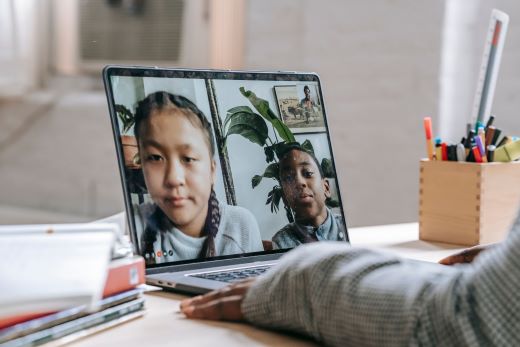
A family film on a Friday evening is not the same as solo gaming until midnight. A video call with a grandparent is not the same as scrolling social media. A neurodivergent child finding their community in an online gaming group is not the same as passive consumption. Ask the question: what is this particular screen experience doing for this particular child?
A note for parents of neurodivergent children

If your child finds in-person interaction hard, and many children do, I want to be direct with you about this.
The goal is not to replicate the social experience of a neurotypical child. The goal is to find the conditions under which your particular child can experience genuine connection, belonging, and the felt sense that they are not alone in the world.
For some children, those conditions exist in a classroom or a sports team. For others, they exist in an online community where the shared interest, the shared language, and the relative anonymity of a screen removes some of the barriers that make face-to-face interaction so draining.
If your child has found their people online, that is real. It counts. It does not replace in-person connection wherever that is possible, but it deserves to be respected as the genuine social need it is meeting.
Your job, in that case, is not to remove it. It is to make sure it is safe, limited, and one part of a rich enough life that it does not become the only part.
What I am still working on
I want to be honest that I do not have this sorted. I still find myself wincing when I see how much time can disappear into a screen. I still have the instinct to remove devices first and ask questions later.
What the panel shifted for me was not my values. I still believe in delayed smartphones, limited gaming, and screen-free time as the foundation. What changed was my willingness to hold those beliefs a little more loosely when the child in front of me is wired differently from the child I was imagining when I formed them.
Reflective parenting has always required us to adapt our framework to the actual child we have, not the one we expected.
The principle matters. The application has to be flexible enough to serve the real human being in front of you.
With so much love,
Lisel
PS: If this resonates and you are struggling with finding a way to navigate these limits at home, please reach out to me at lisel@ourflourishingfamilies.com for a confidential, safe discussion.
Related blog stories


Join our community